
Guide
How to Take Payments for Yoga Classes — A UK Guide to Getting Paid Without the Hassle
A UK guide to taking card payments as a yoga teacher — cash, bank transfer, Stripe, and integrated booking. Every option, honestly assessed, with no jargon.
You became a yoga teacher to teach yoga — not to chase payments. Yet here you are, texting students reminders, waiting for bank transfers to land, and doing mental arithmetic at the door to work out who’s paid for tonight’s class.
Knowing how to take payments for small business — especially as a solo operator — doesn’t need to be complicated or expensive. But the options are genuinely varied — from cash and bank transfer through to card readers and fully integrated booking systems — and the right one depends on where you are right now.
This guide covers the whole UK payment landscape for yoga teachers. Every method, honestly assessed, with the trade-offs upfront. By the end, you’ll know exactly which payment approach fits your classes — and what a properly integrated system looks like when it all works together.
Already taking bookings and just want to connect payments? Jump to Setting up payments with Woven →
The Real Cost of Getting Paid the Wrong Way
Before looking at the options, it’s worth naming the actual problem. Most yoga teachers underestimate how much time the payment admin takes.
- A student says they’ll pay later. You remember. You text them. They don’t respond. You ask again before the next class. Awkward.
- Three students did bank transfers this week. One labelled it wrong. You’re squinting at your banking app trying to match names to classes.
- Someone books via WhatsApp. You assume they’ll pay at the door. They don’t show up. The spot was held. Another student couldn’t get in.
The money lost to no-shows is visible. The time lost to chasing, reconciling, and awkward conversations is invisible — but it adds up fast.
Every payment method has a different answer to the no-show problem and the chasing problem. That’s the lens to use when you’re choosing.
The Old Ways: Cash and Bank Transfer
These aren’t wrong. They’re just limited — and the limitations matter more as you grow.
Cash
Zero fees. No setup. Every client understands it. Cash is genuinely fine for small community classes where you know all your students personally and no-shows aren’t a financial issue.
The problem: cash at the door gives clients zero commitment. They’ll “come along later” and not tell you they’re not. You’ve got a full class on paper and three empty mats. No data trail, no record of who paid what for which class, no way to build a client history.
Works for: one-off community events, small regular groups of five or fewer where everyone shows up.
Breaks at: anything bigger, anything where capacity matters, or anything where you want to track what you’re earning.
Bank Transfer (BACS / Faster Payments)
Free to send, free to receive. Clients can pay from their phone in 30 seconds. No processing fees — unlike every card payment method, bank transfer is completely free.
The catch: you’re waiting. You’re checking your banking app. You’re chasing when people forget. “I’ll sort it tonight” is the yoga teacher’s version of “the cheque’s in the post.” And with bank transfers, you’re manually reconciling who paid what — nothing links a payment to a specific class or booking.
Direct debit (GoCardless, Modulr) is a step up from ad hoc bank transfer. It works well for monthly membership models where you charge a fixed amount on a set date. But for pay-per-class — which is how most UK yoga teachers operate — direct debit is overkill and the setup friction isn’t worth it.
Works for: small regular groups where students reliably pay in advance, or as a backup method for clients who don’t have cards.
Breaks at: any scale where you need to know who’s paid before class starts, or where chasing isn’t something you want to do.
The Middle Ground: Card Readers and Payment Links
These solve the “how do clients pay by card?” question. They don’t solve the booking problem.
Card Readers (SumUp, Square, Zettle)
Tap-to-pay at the door. Quick, familiar, and clients expect it. SumUp Air is £19 upfront; Square Reader is around £16. Processing fees are 1.69–1.75% per transaction. If you want to take card payments as a small business without any upfront commitment, a card reader is the simplest entry point.
What card readers don’t do: connect to your bookings. A client taps their card — that’s a payment record in SumUp or Square, completely separate from any record of who booked what class. You’re still reconciling manually. And you’re still taking payment at the door, which means no advance commitment from your students.
Works for: workshops, markets, one-off events where walk-ins are expected and you don’t care about tracking bookings.
Breaks at: regular classes where you need advance commitment, capacity management, or a booking history per client.
Stripe Payment Links
Generate a link, send it via WhatsApp or email, client pays on their phone. 1.5% + 20p per UK card transaction. No hardware, no app needed. Stripe’s payment page is familiar and trusted.
This is a genuine step forward from bank transfer — payment is instant and confirmed. But you’re generating links manually, tracking who you’ve sent them to, and following up on unpaid links. It’s better than chasing bank transfers. It’s still manual.
A payment link for small business like this is also useful when you’ve added a client to a class yourself — more on that in the integrated section below.
Works for: one-off payments, workshops where you want card payment but don’t have a full booking system yet.
Breaks at: regular high-volume classes where generating and tracking links for every booking isn’t sustainable.
PayPal Invoicing
Familiar to clients who already have PayPal. But the fees are higher — around 2.9% + 30p per transaction on standard business accounts — and there’s no integration with your class schedule. You’re running a payment tool and a booking tool as completely separate systems.
Works for: clients who are uncomfortable with Stripe or don’t have cards.
Breaks at: anything where fee efficiency matters, or where you want payment and booking to be connected.
The Modern Answer: Integrated Booking and Payment
The best payment method for yoga classes isn’t really a payment method. It’s a system where payment happens automatically as part of booking.
Here’s the flow:
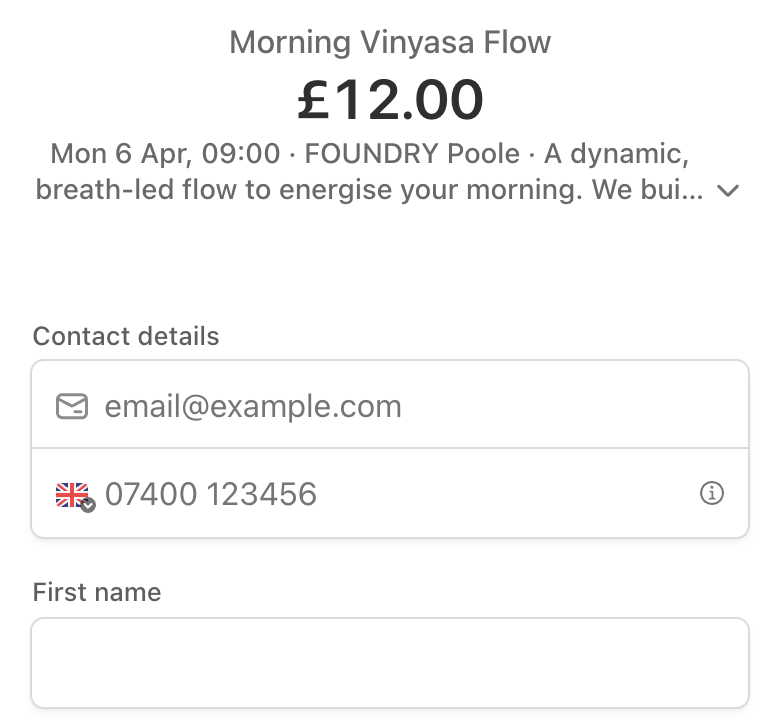
- Client finds your class on your public booking page
- Taps “Book” — sees the class name, time, price, and spaces remaining
- Enters their name and phone number. No account, no app.
- Pays by card on Stripe checkout — Woven never sees or stores card data
- Gets an instant WhatsApp confirmation — booking confirmed, class details attached
See exactly what your clients experience when they book →
Under a minute from start to confirmed. No chasing. No reconciling. No separate payment step.
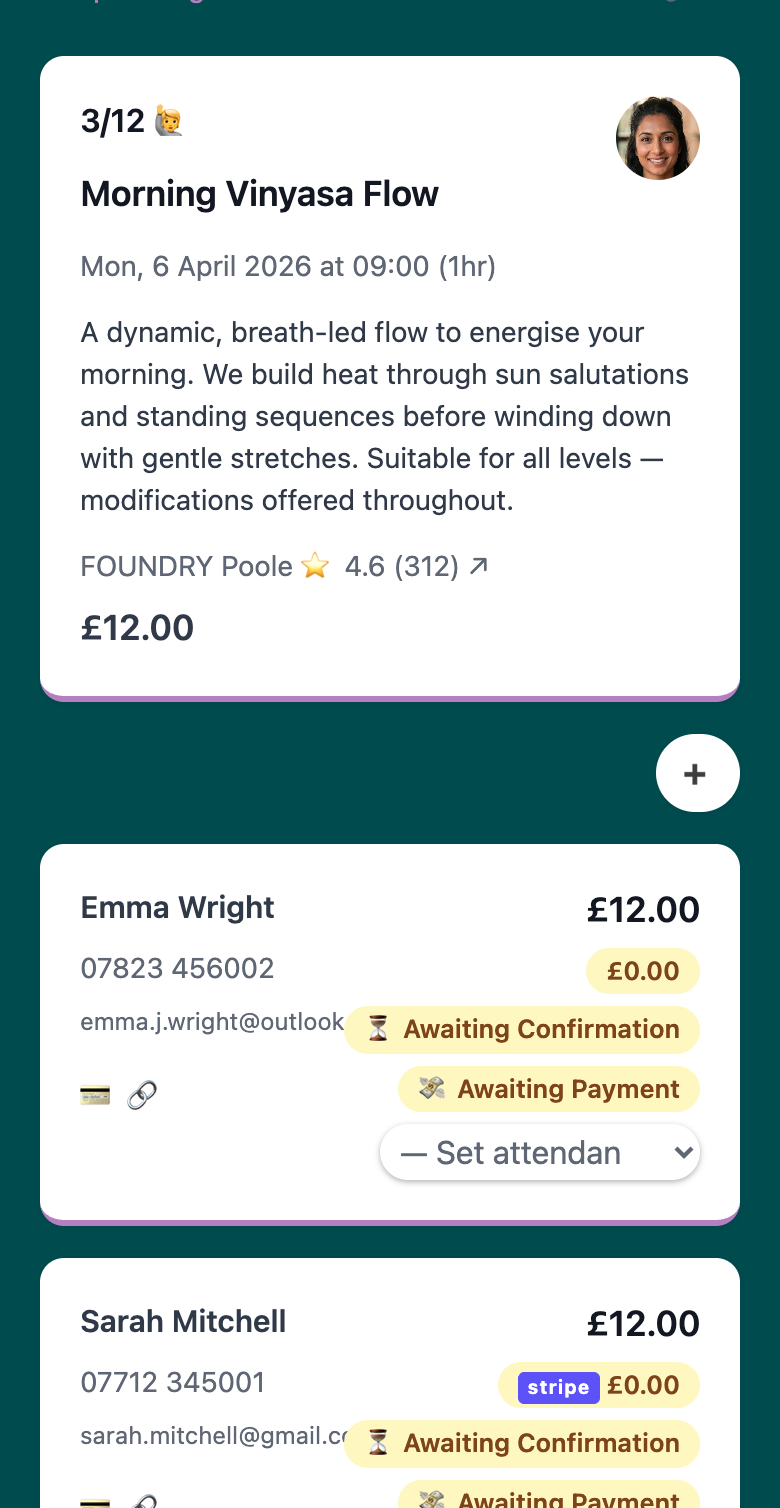
What you see in your admin: every booking, every payment status, who’s confirmed for tonight’s class. Before you get there, you already know who’s paid and who hasn’t — no asking at the door.
Payment Links for Edge Cases
You added a client manually? They couldn’t complete the online flow? Generate a Stripe payment link from their booking card — one tap. Copy it, send it via WhatsApp. Valid for 24 hours.
If you change the class price while a link is active, it’s immediately invalidated and marked “Expired (Price Changed)” — so clients can never be charged the wrong amount. You’ll see the flag and can generate a fresh link at the updated price.
Custom Pricing Per Booking
Not every client pays the same rate. Teacher training students, concessions, loyalty discounts — you can set a custom price on any individual booking without changing the class price for everyone else. The payment link charges that client at their adjusted rate. Everyone else pays full price.
For a full walkthrough of how Woven’s payment processing for small business works end-to-end, see Taking payments for classes with Woven →
Card Payments for Small Business UK — What Yoga Teachers Need to Know
Stripe Is the Right Processor for UK Small Businesses
Stripe is the dominant payment processor for UK small businesses, and for good reason. UK card fees are 1.5% + 20p per transaction — considerably lower than PayPal (2.9% + 30p) and comparable to card readers (1.69–1.75%) but with the convenience of fully online payment.
Stripe is PCI Level 1 compliant. Your clients’ card details are entered directly on Stripe’s hosted checkout page — they never pass through Woven’s servers and are never stored by Woven. For your clients, paying feels like any standard UK e-commerce checkout.
What About GDPR?
A common concern: “If I’m taking online payments, am I storing sensitive card data?” The short answer is no.
When clients pay through Stripe, the card data lives entirely with Stripe — that’s Stripe’s responsibility, not yours. Woven stores names, phone numbers, and booking history — standard business data that every small business collects. There’s no special GDPR obligation for card data because you never hold it.
What you should have in place: a privacy notice on your website explaining how you use client contact details. A one-paragraph statement is sufficient for most yoga teachers. Gov.uk’s ICO guidance has a plain-English version for small businesses.
Direct Debit — When It Makes Sense
GoCardless and similar services offer direct debit at around 1% + 20p per transaction — lower fees than Stripe. But direct debit is built for recurring fixed-amount charges: monthly memberships, subscriptions.
For pay-per-class bookings (the standard yoga teacher model), direct debit is friction without benefit. You’re asking clients to set up a mandate for a variable-frequency, variable-amount service. Most won’t bother. Stick with Stripe for pay-per-class, and revisit direct debit if you introduce a monthly unlimited membership.
A Note on Pricing Your Classes
UK yoga classes average £8–15 per drop-in session (higher in London, lower in community settings). Whatever you charge, card processing shouldn’t eat into your margin meaningfully.
Woven’s total cost on a £12 class: 1.5% platform fee (18p) + Stripe processing (1.5% + 20p = 38p). Total: 56p, or just under 5% of £12. On a £15 class, the same calculation comes to 63p — 4.2%.
For comparison: a £30 per hour therapist running 10 sessions a week pays around £6.30/week in processing fees. That’s the scale you’re working with. The bigger cost is still the no-shows you lose when payment isn’t collected at the point of booking.
Which Payment Method Is Right for You?
| Method | Fees | Advance payment? | Booking integration? | Best for |
|---|---|---|---|---|
| Cash | £0 | ❌ | ❌ | Small community classes, one-offs |
| Bank transfer | £0 | ⚠️ you chase | ❌ | Small regular groups, backup |
| Card reader | ~1.7% | ❌ | ❌ | Workshops, markets, walk-ins |
| Stripe payment link | 1.5% + 20p | ✅ | ❌ | One-off charges, manual sends |
| Integrated (Woven) | 1.5% + Stripe | ✅ | ✅ | Regular classes, any scale |
The jump that makes the biggest practical difference isn’t cash to card — it’s manual to integrated. Once payment is part of booking, the no-show problem and the chasing problem both largely disappear. For most yoga teachers looking to take card payments for their small business, integrated is the end destination — everything else is a stepping stone.

Tips — Getting Paid Faster as a Yoga Teacher
- Collect payment at the point of booking, always. Students who’ve paid are 40–60% less likely to no-show than students who haven’t. The commitment of payment changes behaviour.
- Send payment links via WhatsApp. It has the highest open rate of any messaging channel in the UK. A payment link sent in WhatsApp gets paid faster than one sent by email.
- Price to absorb the transaction cost. A £12.60 class price is awkward. A £13 class is fine. Build the fee in rather than displaying it as a surcharge — clients won’t notice 40p, but they’ll remember a surcharge.
- Use custom pricing for concessions, not separate class listings. One class, multiple price points per attendee — cleaner admin, simpler reporting.
- Check payment statuses before you leave for class. Five minutes before you set off, open the class detail. You already know who’s confirmed, who’s on “Awaiting Payment,” and whether anyone needs a nudge.
Ready to stop chasing payments? See how Woven’s payment processing works →
Related: