
Guide
How to Reduce No-Shows and Cancellations in Your Yoga Classes
A practical guide for UK yoga teachers on reducing no-shows and late cancellations — with a copyable cancellation policy template and attendance tracking tips.
Every yoga teacher knows the feeling: you’ve planned the class, set up the space, and two people who booked haven’t shown up. No message, no warning. Just empty mats and a slightly deflated room.
Knowing how to reduce no-shows for yoga classes takes more than sending a polite reminder. The teachers who keep empty mats to a minimum build a system: upfront prevention, a clear cancellation policy, and the data to spot drifting clients before they disappear.
This guide covers all three.
Why No-Shows Hit Harder for Solo Yoga Teachers
A studio with 30 students barely notices three no-shows. A solo teacher with eight students has just lost 37% of the room’s energy — and the same percentage of that session’s revenue.
The economics are different when you’re running small classes. Empty mats aren’t just wasted space:
- Revenue lost on the day — that spot could have been filled by a waitlisted client
- Class energy affected — six people in a room designed for ten changes the atmosphere
- Your planning is wrong — you’ve prepared for eight, you’re teaching five
Industry no-show rates for group fitness are typically 10–20%. Bringing yours below 10% is achievable with the right systems in place. The teachers who get there don’t accept no-shows as inevitable — they understand what causes them.
Three Types of Cancellation — And Why They Need Different Fixes
Not all no-shows are the same problem. Treating them as one leads to generic advice that doesn’t land.
1. Forgotten bookings The client booked two weeks ago, life moved on, and the class slipped their mind. This is the biggest bucket by far — and it’s almost entirely solved by reminders. No fee, no policy, no friction needed. Just a timely message in a channel they actually check.
2. Low-commitment bookings Booked on impulse or out of social obligation. No financial stake at the point of booking means the class is easy to skip when something better comes up. Policy and upfront payment both address this — the commitment has to be real at the time of booking, not retroactive.
3. Genuine life events Something happened. These can’t be eliminated. They can be managed by making cancellation easy (freeing the spot for someone else) and by keeping the human side of your response warm rather than punitive.
Most advice treats all three as one problem. The strategies below are mapped to the type — so you know which fix to reach for first.

Five Strategies to Reduce No-Shows (And Why Each Works)
These aren’t generic tips. Each one targets a specific cause and explains the mechanism.
1. Take Payment at Booking
Pre-payment is the single most effective change you can make. A client who has already paid is far less likely to skip — the class is money they’ve spent, not money they might owe.
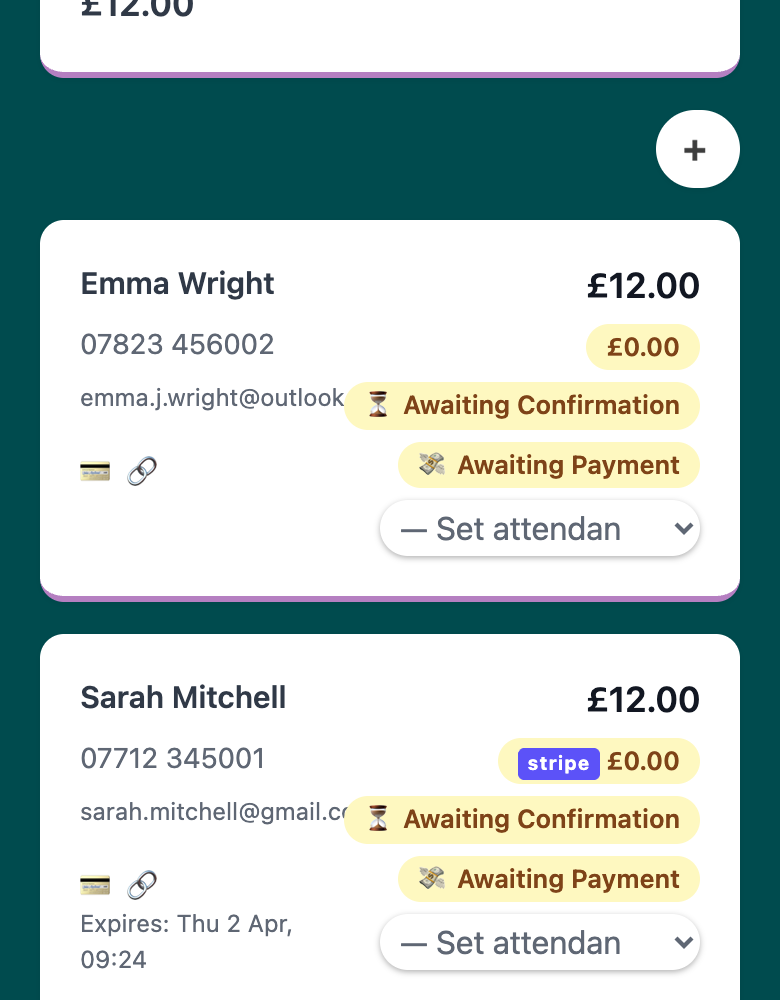
Woven sends a payment link at the time of booking with a 24-hour expiry. That expiry matters: it creates a real decision point. The client either pays and commits, or the spot opens back up automatically. No chasing, no awkward messages.
Pre-payment also removes the need for a no-show fee entirely. The commitment is already made. → How online booking works for your clients
2. Send Reminders via WhatsApp, Not Just Email
Email open rates for small business communications hover around 20–30%. WhatsApp open rates are above 90%. Most of your clients are already using WhatsApp to communicate with you — automated class reminders land in the same place.
Woven sends automated WhatsApp reminders for upcoming classes. The timing that works best for most teachers: 24 hours before the class, plus a second reminder 1–2 hours before. The first reminder catches people in time to cancel if they can’t make it (good for your waitlist). The second catches the genuine forgetting.
The channel matters as much as the message.
3. Set a Clear Cancellation Window — and Enforce It
A cancellation policy only works if clients know it exists before they book, not after they’ve missed the class.
For weekly group classes: 12–24 hours is a reasonable window. It gives you time to notify waitlisted clients and gives them time to book in. For workshops or retreats: 48–72 hours, because the commitment (and the cost) is higher.
Woven displays your cancellation policy at the booking step — not buried in a confirmation email, but visible at the moment of booking. That’s when it shapes behaviour.
The window itself is less important than consistency. A policy you enforce occasionally is worse than no policy at all — it teaches clients that the rule is negotiable.
4. Use a Waitlist to Recover Cancelled Spots
A cancellation only becomes lost revenue if the spot stays empty. Automated waitlist notifications mean cancelled spots fill themselves.
When a booking is cancelled, Woven notifies the next person on the waitlist with a direct booking link. The spot is recovered without any manual work from you. For popular classes, this makes cancellation feel less costly for the client (they know someone else gets the spot) and keeps your revenue consistent regardless of last-minute changes.
→ How to create and manage classes · Class Management
5. Make Cancelling Easy
This one feels counterintuitive — but friction around cancellation leads to no-shows, not fewer cancellations.
When cancelling is difficult (long forms, no link, awkward message to send), clients avoid it. The class silently fills with ghost bookings. Easy cancellation means spots free up early enough for your waitlist to fill them. The goal isn’t to minimise cancellations — it’s to minimise empty mats.
Each Woven class has its own shareable URL. Clients can check in on their booking, cancel if they need to, and the spot moves to the next person automatically. The fewer steps involved, the more likely they are to cancel rather than simply not show up.
Your Yoga Cancellation Policy — A Template You Can Copy
Every month, yoga teachers across the UK search for a cancellation policy template. Here is one. Short, human, and covers everything it needs to.
[Your Name] — Cancellation Policy
I ask for at least [12 / 24] hours’ notice if you need to cancel a class booking.
To cancel: use the cancellation link in your booking confirmation, or message me directly on WhatsApp.
- Cancellations with [X] hours’ notice: your class credit is returned in full.
- Late cancellations (within [X] hours) or no-shows: the class fee is non-refundable. This is because your spot could have been offered to someone on the waitlist.
- Emergencies and illness are always considered on a case-by-case basis — just message me.
I appreciate your understanding. It helps me run classes fairly for everyone.
Where to show it:
- In your class description — visible at the booking step in Woven
- In your booking confirmation message — first touchpoint after they pay
- In a pinned WhatsApp message to your regular clients
The policy earns its keep when it’s visible, consistent, and communicated kindly.
Turning Attendance Data Into a Retention Signal
This is where Woven’s approach goes beyond reminders and policies. Managing no-shows tactically (fixing individual missed sessions) is different from managing client retention strategically (spotting who’s drifting before they leave).
Woven records an attendance status for every booking after each class. The options are:
- 🙋 Attended
- 🤨 Attended (Late)
- 👎 No Show (Notified Me)
- 🤢 No Show (Unwell)
- ⛔️ No Show (No Contact)
As you record these after each class, a picture builds. Not just of individual sessions — of clients.
The track → spot → act framework:
Track. After each class, mark attendance status for every booking. It takes 30 seconds and it’s the foundation for everything else.
Spot. In your client list, sort by attendance rate. A client who attended 10 of 10 classes and then misses three in a row isn’t just a pattern of no-shows — it’s an early signal that they may be about to drop off entirely. Filtering by attendance rate surfaces these clients immediately.
Act. Reach out before they disappear. Not a policy reminder — a human message. “Haven’t seen you for a few weeks — hope everything’s okay.” That message, sent at the right moment, converts a quiet departure into a conversation. Sometimes the client just needed someone to notice.
This is the difference between reacting to individual no-shows and managing client retention as a system. Both use the same attendance data — the second one just goes one step further.
→ Managing your clients in Woven covers client filtering and attendance rate sorting in detail.
See how Woven tracks attendance and sends WhatsApp reminders automatically →
What to Do After a No-Show
A no-show doesn’t have to end the relationship. Most of the time, something happened — it wasn’t malice or indifference. The response that works best isn’t enforcement — it’s human.
A simple follow-up message:
“Hi [Name] — missed you at [Class] today. Hope everything’s okay. We’d love to see you next time — here’s the link to book.”
Short, warm, non-punitive. It signals that they were missed (good for community), opens a door if something’s wrong, and makes rebooking one tap away.
A few principles for no-show follow-up:
- Message within 24 hours. Same day if possible — context is still fresh
- Don’t lead with the policy. You can mention it if it’s a repeat occurrence, but policy as an opener closes the conversation before it starts
- Include a rebook link. Remove friction from the action you want them to take
- Note it in Woven. Client notes are useful — “missed 3 in a row, reached out Oct” is helpful context next time you look at their record
The clients who feel noticed and valued rebook. The clients who feel like a number drift to whoever treats them better.
Tips for Reducing No-Shows as a Yoga Teacher
🔑 Your reminder timing matters more than your reminder content. 24h before + 1h before is the proven pattern. The first gives them time to cancel. The second catches genuine forgetting.
📋 Display your policy at booking, not in a confirmation email. By the time the confirmation lands, the booking is done. The policy needs to be visible at the moment of commitment.
🔄 Record attendance status consistently. Inconsistent tracking means the retention signal doesn’t build. 30 seconds after each class is all it takes.
✉️ Make cancellation easier than avoidance. If cancelling requires more effort than ignoring the class, clients default to ghosting. One link in the confirmation email fixes this.
💬 Follow up warmly, not formally. The teachers who retain clients long-term treat no-shows as a human moment, not a compliance issue.
Related: