
Comparison
The Best Yoga Studio Software For UK Teachers — Compared
Side-by-side comparison of 4 yoga studio software options for UK teachers. Real pricing, honest weaknesses — including the hidden costs nobody else covers.
What Makes Good Yoga Studio Software?
Before comparing tools, it helps to know what actually matters for a class-based business. Yoga studio software isn’t the same as a general appointment scheduler — your clients book into group sessions, payments need to land before someone takes a spot, and the relationship between teacher and client runs for months, sometimes years.
These are the criteria that separate tools built for yoga teachers from tools that just happen to work:
- Class scheduling and booking — recurring classes, capacity management, per-session sharing links, and the ability to cancel or reschedule a single session without disrupting the whole series
- Waitlist management — automatic waitlists when a class fills, and instant notification to waiting clients when a spot opens. First-come, first-served — no manual coordination
- Payment handling — upfront payment at the point of booking, class passes, memberships, and automated billing that closes the gap between booking and payment
- Client management — attendance history, client notes, spend tracking, and filters that surface who’s drifting before they actually leave
- Cancellation management and reduction — reminders sent through the right channel (WhatsApp’s 95%+ open rate vs email’s 20–30%), attendance status tracking, and patterns that tell you who to reach out to before they go quiet
- Automated communication — booking confirmations, reminders, group messaging. Channel matters: WhatsApp reaches your clients where they already are
- Reporting and business insights — revenue, attendance trends, retention data
- Mobile usability — you’re between classes, not at a desk. Your clients are booking on their phones
- UK suitability — GBP pricing, GDPR compliance, UK-based support, UK payment processors
With these criteria established, here’s how the four platforms UK yoga teachers actually consider compare.
Woven — Built For Independent Yoga Teachers
Woven is UK-native software built for independent service businesses — yoga teachers, personal trainers, pilates instructors running their own practices. It handles the full client lifecycle: booking, payment, communication, attendance tracking, and client management.
Best for: Solo yoga teachers and small group practices who want everything in one place without paying for features they don’t need.
Strengths:
- WhatsApp-first booking — clients book directly from your public page. No app download, no account creation — just a name, phone number, and card payment. Booking confirmation and reminders land on WhatsApp (95%+ open rate vs email’s 20–30%)
- Payment at booking — Stripe Checkout built in, 24-hour payment links, per-attendee custom pricing. If someone doesn’t pay, the place isn’t confirmed. No chasing
- Attendance status tracking — five statuses (Attended, Attended Late, No Show Notified, No Show Unwell, No Show No Contact) that build into each client’s profile. Spot who’s drifting before they disappear
- Client management — full booking history, notes, spend, attendance rate, and filters that let you sort by any metric. No CRM subscription needed
- Per-class sharing URLs — each class gets its own link that previews properly on WhatsApp, iMessage, and social. Drop it into a group chat, not just your main page
- UK-native — GBP throughout, UK support, UK payment processors
Weaknesses:
- New to market — smaller community and ecosystem than established tools
- Feature set is growing — class passes and memberships are not yet available
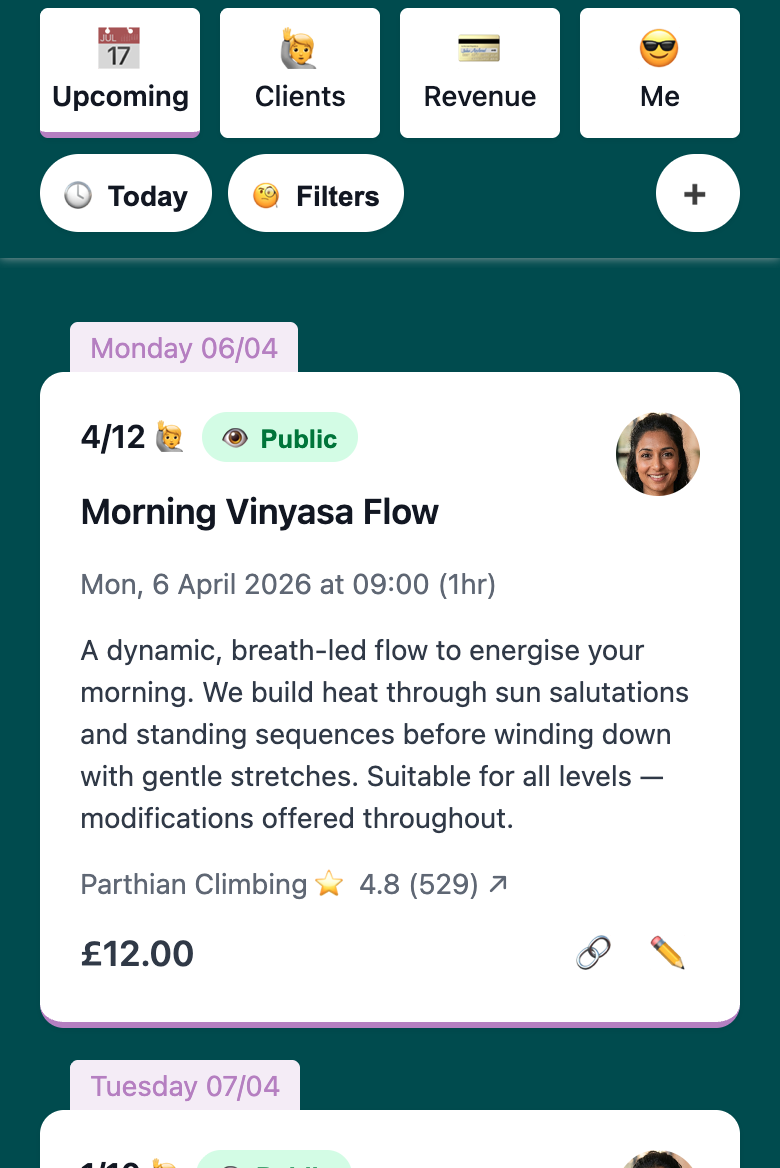
Pricing: 🎉 1.5% per transaction. No monthly fee. If you have a quiet month, you pay nothing. Stripe’s standard card processing fees apply separately.
Waitlist management: Coming soon — when a class is full, clients will have the option to join a waitlist. When someone cancels, everyone on the waitlist gets an alert and it’s first-come, first-served. This is built for independent teachers, not a complex lottery system.
Momoyoga — Yoga Community Platform
Momoyoga is Netherlands-based software built specifically for yoga teachers and yoga studios. It’s the most recognisable yoga-specific brand in the category — branded search for “Momoyoga” runs at around 1,300 searches per month in the UK alone.
Best for: Yoga teachers who want a yoga-branded platform with a strong community and video on-demand capabilities.
Strengths:
- Purpose-built for yoga — the interface is clean, yoga-native, and less intimidating than enterprise gym software
- Class passes and memberships on Standard and above
- Video on-demand for online and hybrid studios
- Waitlist available on Standard plan and above
- Established community — lots of tutorials, peer support, and integrations
Weaknesses:
- Netherlands-based — pricing is in EUR, not GBP. Currency conversion adds unpredictability to your costs
- Email-only reminders — no WhatsApp integration. Email open rates are 20–30% vs WhatsApp’s 95%+. Your reminders may not land
- No cancellation analytics — you know someone didn’t come, but there’s no structured data to help you act on it
- No UK-specific support
Pricing:
- Free plan: 5% platform fee on all bookings (paid to Momoyoga, not Stripe fees)
- Standard: €29–39/month
- Plus: €59–79/month
- 14-day trial available
At the Standard tier, you pay ~£25–33/month plus Stripe fees. The free tier looks attractive, but 5% on every booking adds up fast — on a £15 class with 10 attendees, that’s £7.50 to Momoyoga per session.
TeamUp — Group Fitness Platform
TeamUp is UK-based, built for group fitness broadly. It’s not yoga-specific, but it’s well-regarded for studios with multiple instructors, complex timetables, and integrated Zoom for hybrid classes.
Best for: Small studios with 2+ instructors who need strong scheduling, staff management, and reporting across multiple class types.
Strengths:
- UK-based — GBP pricing, strong UK customer support
- All features included at every pricing tier — no feature gating
- Strong reporting and business analytics
- Zoom integration for online and hybrid classes
- Stripe and GoCardless payment support
- Established product with large user base
Weaknesses:
- Per-client pricing model — costs grow directly with your success. £79/month at 0–100 clients becomes £269/month at 600+ clients
- Not yoga-specific — you get generic fitness software features, not a yoga-native interface
- No WhatsApp integration — email reminders only
- Potentially expensive at scale for a solo teacher who grows a large client base
Pricing:
- Scales from £79/month (up to 100 active clients) to £269/month (600+ active clients) in 100-client increments
- All features included at every tier. 30-day free trial.
The model works well if you have a stable, smaller client base. A solo teacher with 50 active clients pays £79/month for more functionality than they may need. A growing studio with 300+ clients pays £149–269/month — which starts to become significant overhead.
Mindbody — The Industry Incumbent
Mindbody is US-based enterprise-scale software that dominates the fitness and wellness industry. It operates as both a studio management platform and a consumer marketplace — clients can discover your classes through the Mindbody app.
Best for: Established studios with significant revenue, multiple instructors, and the resources to manage a complex onboarding process.
Strengths:
- Most comprehensive feature set in the market — advanced analytics, AI assistant, branded app, complex membership structures
- Consumer marketplace — your classes are discoverable to Mindbody’s existing user base
- Enterprise-grade reporting and multi-location management
- Branded app available on Ultimate Plus
Weaknesses:
- Pricing and complexity are designed for large studios, not independents. The learning curve is steep
- Opaque pricing — the headline monthly fee is just the start
- US-centric — GBP pricing is available, but the product decisions and roadmap reflect a US market
- Marketplace commission on first purchases — ~£24 cap on the first booking from a new Mindbody client. You pay to acquire clients you might have already had
- No WhatsApp integration
Pricing:
- Starter: ~£109/month
- Accelerate: ~£229/month
- Ultimate and Ultimate Plus: higher (quote-based)
- Plus: ~3.5% transaction fees on all bookings
- Additional potential costs: marketplace commission (capped ~£24 on first client purchase), onboarding/setup fees, training fees
The total cost of ownership for a solo teacher on Mindbody Starter is roughly £109/month + 3.5% on all transactions + potential marketplace commission. On a typical week of 3 classes × 10 clients × £15 = £450/week revenue, the 3.5% transaction fee alone is ~£62/month on top of the subscription.
Yoga Studio Software Compared — Side-By-Side
| Feature | Woven | Momoyoga | TeamUp | Mindbody |
|---|---|---|---|---|
| Class scheduling | ✅ | ✅ | ✅ | ✅ |
| Waitlist management | 🔜 Coming soon | ✅ (Standard+) | ✅ | ✅ |
| Payment at booking | ✅ | ✅ | ✅ | ✅ |
| Class passes & memberships | 🔜 Coming soon | ✅ (Standard+) | ✅ | ✅ |
| Automated reminders | ❌ Email only | ❌ Email only | ❌ Email only | |
| Client management & notes | ✅ | ✅ Basic | ✅ | ✅ |
| Attendance tracking (granular) | ✅ 5 statuses | Basic | Basic | ✅ |
| Cancellation analytics | ✅ | ❌ | Partial | ✅ |
| Mobile usability | ✅ | ✅ | ✅ | ✅ |
| UK-native (GBP, support) | ✅ | ❌ EUR | ✅ | ❌ US-centric |
| WhatsApp integration | ✅ | ❌ | ❌ | ❌ |
| Consumer marketplace | ❌ | ❌ | ❌ | ✅ |
| Starting price | 1.5% per transaction | Free (5% fee) or €29/mo | £79/mo | ~£109/mo |

How Much Does Yoga Studio Software Really Cost?
The monthly subscription number is rarely the whole story. Here’s what you actually pay:
| Platform | Monthly fee | Transaction fee | Hidden extras |
|---|---|---|---|
| Woven | £0 | 1.5% + Stripe fees | None |
| Momoyoga Free | £0 | 5% platform fee + Stripe fees | EUR pricing — conversion costs |
| Momoyoga Standard | €29–39/mo (~£25–33) | Stripe fees only | EUR pricing |
| TeamUp | £79–269/mo | Stripe/GoCardless fees | Per-client pricing model |
| Mindbody Starter | ~£109/mo | ~3.5% on all transactions | Marketplace commission, setup fees |
The hidden costs nobody talks about:
- Momoyoga Free’s 5% platform fee — on 3 classes × 10 clients × £15, that’s £22.50/month to Momoyoga before Stripe fees. You’d be better off on the Standard plan at €29/mo
- Mindbody’s transaction fee stacking — £109/month subscription + 3.5% on all transactions means that on £1,800/month revenue, you’re paying ~£172 in combined platform costs. Plus marketplace commission when Mindbody sends you a new client
- Momoyoga’s EUR pricing — every month your £ → € conversion eats a few percent. Minor individually, but it adds up over a year and makes budgeting harder
- TeamUp’s growth penalty — your software costs increase automatically as your client base grows. A studio that goes from 100 to 300 clients sees their TeamUp bill jump from £79 to £149/month. Success costs you more
At three business sizes:
| Business size | Woven | Momoyoga Std | TeamUp | Mindbody Starter |
|---|---|---|---|---|
| Solo (20 clients, £600/mo revenue) | £9 | ~£25–33 | £79 | ~£130 |
| Small studio (100 clients, £2,000/mo) | £30 | ~£25–33 | £79 | ~£179 |
| Growing (300 clients, £5,000/mo) | £75 | ~£50–65 | £149 | ~£284 |
Woven figures = 1.5% platform fee only; Stripe fees additional for all providers. Momoyoga figures converted from EUR at approximate exchange rate. Mindbody includes ~3.5% transaction fee estimate.

Choosing The Right Yoga Studio Software For Your Business
The right platform depends on where your practice is right now — and where it’s headed.
If you’re a solo teacher running 2–5 classes per week: What matters most is simplicity, low overhead, and a smooth client experience. You don’t need enterprise reporting or a marketplace. You need something that handles bookings, collects payment, sends reminders, and keeps your client records in one place. Woven or Momoyoga Standard fit this profile. Woven’s 1.5% transaction model means you pay less in a slow month and more when you’re busy — the cost scales with your revenue. Momoyoga Standard gives you a fixed monthly cost and a yoga-native interface.
If you’re a small studio with 2–3 instructors: You’ll value stronger scheduling, staff management, and reporting. TeamUp is built for this profile — all features at every tier, strong UK support, and scheduling tools designed for multi-instructor timetables. The £79/month base cost is the trade-off.
If you’re a growing studio wanting marketplace visibility: Mindbody’s consumer marketplace brings new clients to your door — but you pay for every one of them, and the monthly costs are significant. Before committing, calculate your total cost of ownership: subscription + transaction fees + marketplace commission. Make sure the client acquisition value justifies the spend.
Questions to ask before choosing:
- How do I currently send reminders, and what’s my actual no-show rate?
- Do I need clients to be able to discover me (marketplace), or do I already have my own audience?
- Will I be penalised as I grow? Does the pricing model get worse as my client base increases?
- Does the tool handle class-based bookings, or was it built for appointments?
- What’s the total monthly cost at my current revenue level — subscription + all transaction fees?
5 Things to Check Before Switching Yoga Studio Software
Switching platforms is disruptive. Make sure you’ve checked these before you commit:
- What happens to your existing client passes and memberships? Some platforms make it hard to honour outstanding passes during a transition. Get a clear answer before you start.
- How does the reminder system actually work? Email-only platforms have 20–30% open rates. If your clients live on WhatsApp, an email reminder is often invisible. Ask specifically about WhatsApp — not just “automated reminders.”
- What does it cost at your actual revenue level? Don’t quote yourself the headline monthly price. Calculate: subscription + transaction fee on your typical monthly revenue + any marketplace commission. That’s your real number.
- Does the pricing model penalise growth? Some platforms (TeamUp) charge more as your client base grows. Others (Woven) charge a fixed percentage — your cost scales with revenue, not headcount.
- Can you try it properly before committing? A 14-day trial on a new platform isn’t long enough to test real client relationships. Look for longer trials or a free tier you can run alongside your existing tool before switching fully.
Related:
- How your clients experience booking →
- Taking payments for classes with Woven →
- Client management for small businesses →
- Online booking for small businesses →
Ready to see how Woven works for your yoga practice? Try Woven free