
Comparison
The Best Mindbody Alternatives for Yoga Teachers — And What They Actually Cost
Mindbody is expensive and built for enterprise gyms. Here are the best Mindbody alternatives for yoga teachers UK, with honest pricing compared.
If you’ve found yourself Googling “Mindbody alternatives,” you’re not alone — and you’re not overreacting. The complaints that drove you here are real: pricing that starts at over £100 a month and climbs fast, a 20% cut on clients who find you through their discovery marketplace, a cancellation process that requires a phone call and a written notice period, and a feature set built for multi-location gym chains with front-desk staff.
Mindbody is a powerful platform. It’s just not built for a yoga teacher running eight classes a week.
This page compares the top four yoga booking software options for UK yoga teachers — honestly, with real pricing, and with a clear view of what each option gets right and where it falls short. Including Woven (that’s us). We’ll tell you when Mindbody is actually the right answer too.
Why Yoga Teachers Are Leaving Mindbody
The Mindbody problems that appear in search results aren’t edge cases — they’re the standard experience for small yoga businesses:
- Pricing from the start: The Starter plan is reported at around $129/month (approximately £105). The Accelerate plan — where most of the actually useful features live — is around $299/month (approximately £240). Enterprise features run to $499–$699+/month.
- The discovery fee: If a new client books you through Mindbody’s marketplace, they take roughly 20% of that booking. You pay to appear on their platform, then pay again when it works.
- Payment processing: 3.5% processing fees on top of your monthly subscription.
- Feature gating: Core features like automated marketing, reporting, and class series are locked to higher tiers. The plan you can afford may not include the tools you actually need.
- Contract lock-in: Annual commitments are common, and cancellation is not a quick online process. Multiple customer reviews cite needing to call, send written notice, and fight auto-renewals.
- Data export fee: Reported at around $500 to export your own client data when you leave.
None of this is surprising for a platform built to serve fitness chains with hundreds of members and full-time operations teams. It’s just the wrong fit for a solo yoga teacher or small studio.
What Mindbody Actually Costs — The Full Picture of Mindbody Pricing and Fees
The headline subscription price is only part of the Mindbody cost picture.
| Fee Type | Reported Amount |
|---|---|
| Starter plan | |
| Accelerate plan | |
| Ultimate plan | |
| Payment processing | ~3.5% per transaction |
| Discovery fee (new clients via marketplace) | ~20% per booking |
| Data export (on cancellation) | ~$500 one-time |
| Training / onboarding | Variable, often required |
All competitor pricing in this article is reported by customers and sourced from independent review platforms, published comparisons, and practitioner communities as of 2026. Mindbody does not publish standard pricing on their website.
The annual cost for a small yoga teacher on the Accelerate plan: roughly £2,880/year in subscription fees alone — before payment processing and discovery fees. For a teacher earning £25,000–£40,000 from their practice, that’s a meaningful slice.
The Mindbody fees that catch people off guard:
- The discovery fee applies to every new client who finds you through Mindbody’s app — which is a core selling point of the platform. You’re paying for acquisition, but so is everyone else on the platform, so the competitive advantage is limited.
- The data export fee means switching platforms isn’t free even after you’ve paid for years of service. Your client list — which you built — costs money to take with you.
- Auto-renewal with cancellation friction means many users stay on longer than they intended while navigating the exit process.
What Yoga Teachers Actually Need From Booking Software
Before comparing alternatives, it’s worth being specific about the problem. Here’s what a yoga teacher running classes (not a gym managing memberships) actually needs:
- Class-based scheduling — not appointment booking (which most generic tools do) but session-based classes with capacity limits, multiple attendees, and recurring schedules
- Straightforward payment collection — clients pay at booking; you see who’s paid without chasing
- Client records — attendance history, notes, basic contact info; not a sales CRM
- Automatic reminders — fewer no-shows without manual follow-up messages
- Simple, predictable pricing — you shouldn’t need a finance degree to understand your costs
You don’t need 80% of what Mindbody sells. The question is which platform gives you the 20% you do need, at a price that doesn’t eat your margins.

Compare Top 4 Yoga Booking Software for Yoga Teachers 2026
Here’s a plain-language overview of each platform — where they’re built, what they’re designed for, and how well they serve yoga teachers specifically. All four have been included so you can compare Mindbody directly against the alternatives.
Mindbody — The Enterprise Option
Based in: US (San Luis Obispo, California) Built for: Multi-location fitness chains, gyms, and enterprise studios Yoga specificity: Low — general fitness platform, not built around yoga workflows
Mindbody is the market leader in fitness management software. It serves over 58,000 businesses globally, from boutique studios to national gym chains. The platform covers class scheduling, membership management, marketing automation, staff management, point of sale, and a consumer marketplace that lets new clients discover your business.
The power is real. So is the complexity. Mindbody is built for businesses with front-desk staff, marketing teams, and the operational overhead to get value from an enterprise-grade platform. For a yoga teacher running classes from a studio or community hall, most of what you’re paying for goes unused.
In brief: The most feature-complete platform here, and the most expensive. Worth it at enterprise scale — not for most yoga teachers.
Momoyoga — The Yoga Specialist
Based in: Netherlands (EU) Built for: Yoga studios and pilates teachers exclusively Yoga specificity: High — the only platform here built entirely around yoga
Momoyoga is the purpose-built option. Unlike the other platforms here, it’s designed specifically for yoga and pilates studios — the feature set, the language, and the workflow all reflect how yoga businesses actually run. It’s used across Europe and the Netherlands with a growing UK presence, and its GDPR compliance is straightforward for UK teachers who care about data handling.
What it does well:
- Purpose-built for yoga class scheduling — recurring series, drop-in classes, courses, workshops
- Class packs and memberships included at every tier
- Branded client-facing app
- EU-based (Dutch company) — GDPR handled cleanly
- Free plan available for small studios (up to 10 active students)
- Transparent, tiered pricing
Pricing (reported as of 2026):
- Free: up to 10 active students
- Standard: ~€29/mo (approximately £25)
- Plus: ~€59/mo (approximately £50)
Honest limitations:
- Less polished on mobile admin compared to newer tools
- UK-specific support and integrations are more limited than platforms built for the UK market
- Smaller ecosystem than Mindbody (fewer third-party integrations)
In brief: The clearest choice if you want software that speaks yoga and doesn’t charge enterprise prices. Modest pricing, but EU-based and less deeply integrated with UK payment infrastructure.
TeamUp — The All-Rounder
Based in: UK (London) Built for: Fitness studios, gyms, and class-based businesses broadly Yoga specificity: Moderate — not yoga-specific, but built for the class-based business model
TeamUp is a UK-built fitness management platform that directly targets Mindbody customers at a fraction of the price. It’s not yoga-specific — it serves everything from CrossFit boxes to dance studios — but the core mechanics (class scheduling, memberships, payments) are a clean fit for yoga. The UK base means UK payment processing, UK support, and product decisions made with UK businesses in mind.
What it does well:
- UK-focused — built for UK fitness businesses, UK payment processing, UK support
- All features available at every pricing tier — no feature gating
- Scales well from solo instructors to multi-instructor studios
- Good reporting and retention tools
- Strong integrations (Zoom, Mailchimp, Google Calendar)
Pricing (reported as of 2026):
- From ~£79/mo for up to 200 active members
- Scales to ~£159–£269+/mo depending on volume
Honest limitations:
- Monthly fee applies regardless of class volume — a quiet month still costs £79+
- More feature-complete than most yoga teachers need (built for fitness studios broadly, not yoga specifically)
- Still a meaningful monthly cost for a solo teacher starting out
In brief: The most capable UK-built alternative to Mindbody. Strong value for growing studios — higher cost than necessary for solo yoga teachers just starting out.
Woven — The WhatsApp-First Option (That’s Us)
Based in: UK Built for: Solo service businesses and small class-based teachers Yoga specificity: Moderate — built for the business model, not the discipline specifically
We’ll be straightforward: Woven is us, and this is a comparison page. So here’s an honest account of what we do well and where we’re not yet the right answer.
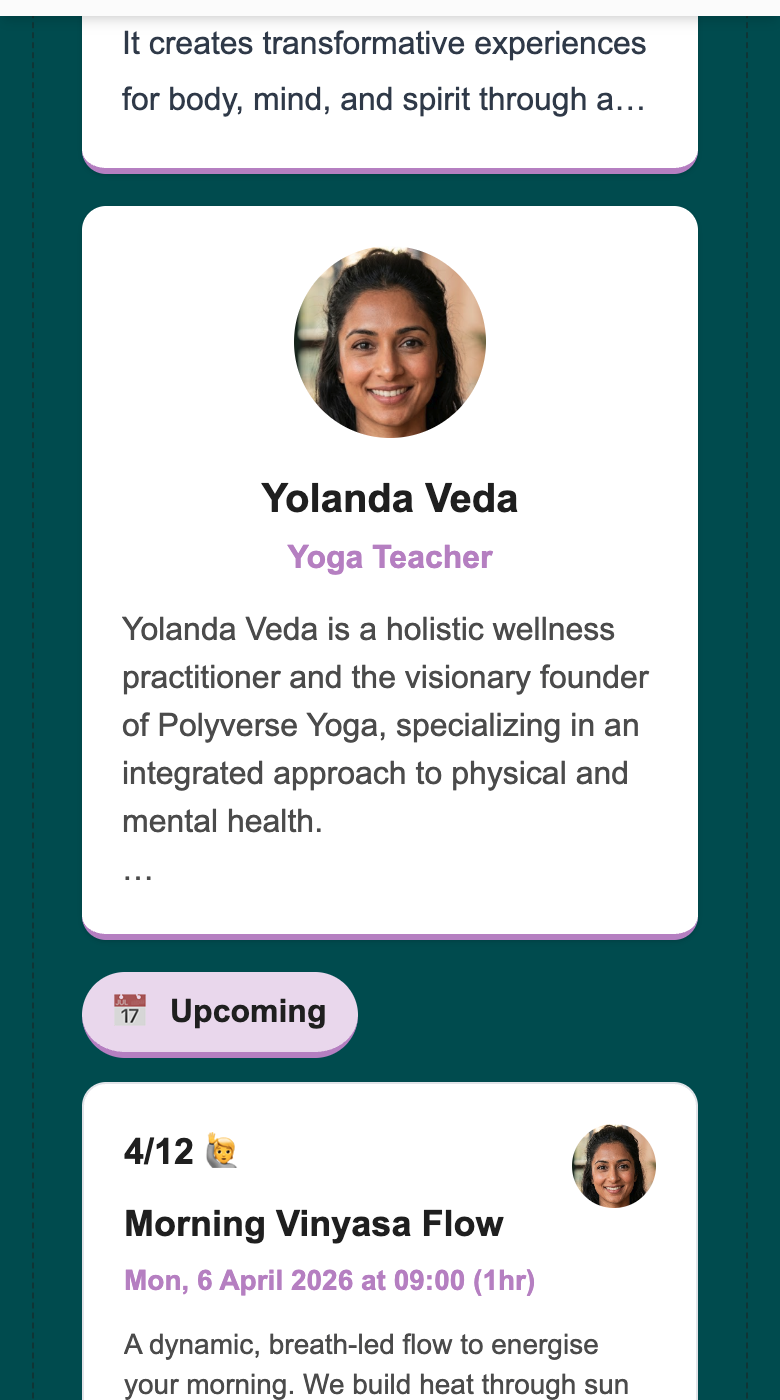
Woven is built for solo service businesses and small yoga teachers who want simple class scheduling, WhatsApp-native client communication, and payment collection — without a monthly fee.
What it does well:
- No monthly subscription. Woven charges a per-transaction fee starting at 1.5% (plus Stripe’s standard processing). You pay when clients book and pay — nothing in a quiet month.
- WhatsApp bookings and confirmations. Clients book through your public page and receive their confirmation on WhatsApp. Reminders go out automatically. No email buried in a spam folder.
- Class scheduling built for small businesses. Create classes, set capacity, publish your schedule, share per-class booking links. Your public business page updates automatically — no website maintenance.
- Client management that’s actually useful. Five attendance statuses, notes per client, booking history, attendance rate tracking. Client management without the complexity — not a CRM, just what a yoga teacher actually needs.
- No contracts, cancel anytime. No written notice periods, no exit fees, no data export charge.
How Woven booking works (how Woven’s online booking works →):
- Your client taps the class link (shareable per session or via your public page)
- They enter their name and phone number — no account to create
- They pay by card through Stripe Checkout — takes under a minute
- They receive a WhatsApp confirmation with class details
- A reminder goes out automatically before the session
Honest limitations:
- No multi-location management yet
- No membership or subscription management (class packs only at this stage)
- Early-stage product — we’re building fast, but we’re not yet feature-complete compared to established platforms
Woven pricing: 🎉 No monthly fee. Starting at 1.5% per booking transaction, plus Stripe’s standard processing. No annual commitment. No exit fees. As we scale, the transaction fee may come down — we’ll always be aligned with your success, not taking a fixed fee regardless of how your classes are filling.
In brief: The lowest-cost option for a solo yoga teacher with modest booking volume. WhatsApp-native client experience that no other platform offers. Best suited to teachers who rely on WhatsApp for client communication and want to avoid fixed monthly fees.
How They Compare: Features, Pricing, and Contracts
Which Has the Best Features for Yoga Teachers?
Feature depth varies significantly across these four platforms — and so does the relevance of those features to an independent yoga teacher.
| Feature | Mindbody | Momoyoga | TeamUp | Woven |
|---|---|---|---|---|
| Class scheduling | ✅ | ✅ | ✅ | ✅ |
| Capacity limits | ✅ | ✅ | ✅ | ✅ |
| Client records + notes | ✅ | ✅ | ✅ | ✅ |
| Attendance tracking | ✅ | ✅ | ✅ | ✅ (5 statuses) |
| Class packs / memberships | ✅ | ✅ | ✅ | Packs only |
| WhatsApp confirmations | ❌ | ❌ | ❌ | ✅ |
| Consumer marketplace | ✅ (20% fee) | ❌ | ❌ | 🔜 Launching |
| Branded public profile | ✅ | ✅ | ✅ | ✅ |
| Marketing automation | ✅ (higher tiers) | ❌ | Partial | ❌ |
| Multi-location | ✅ | ✅ | ✅ | ❌ |
| UK payment processing | ✅ | Partial | ✅ | ✅ (Stripe) |
| No-code public booking page | ✅ | ✅ | ✅ | ✅ |
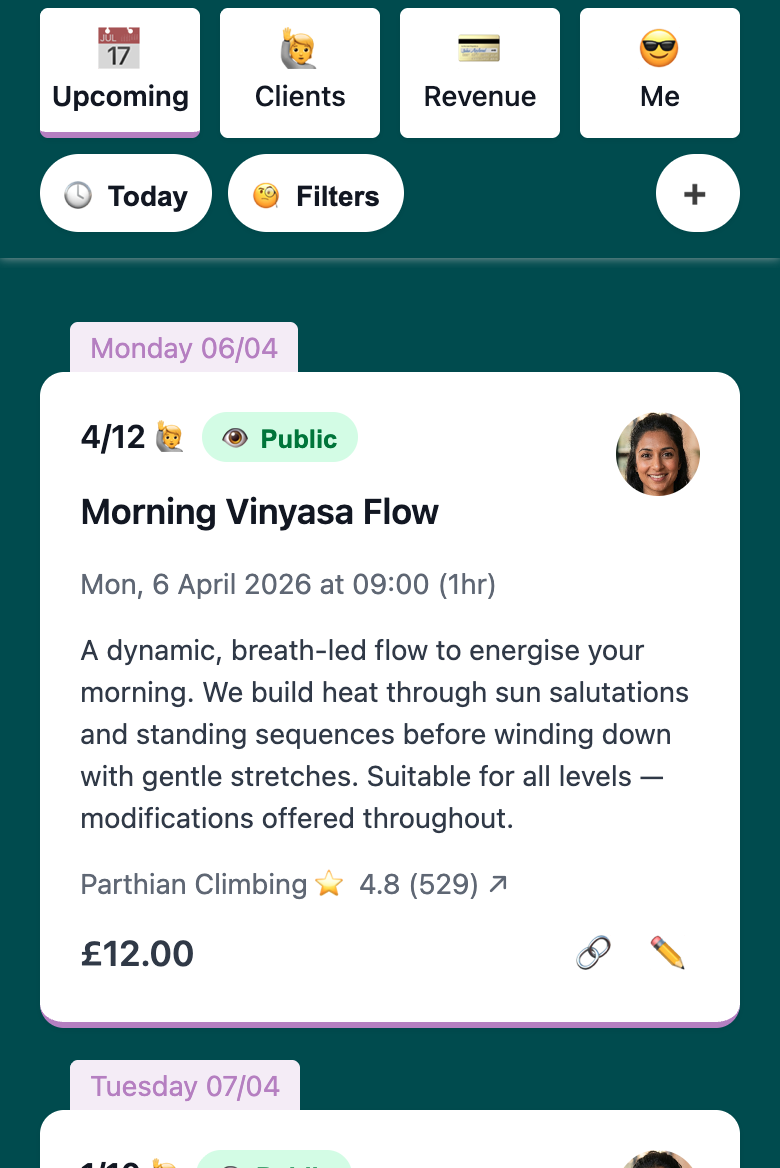
For a yoga teacher running solo: Woven and Momoyoga cover all the essentials without the overhead. TeamUp adds reporting and retention tools that become more useful as a studio grows. Mindbody’s additional feature depth is mostly relevant at scale — multi-location management, staff scheduling, marketing automation — none of which apply to most yoga teachers.
The standout difference: WhatsApp confirmations and reminders. If your clients use WhatsApp (and most UK yoga clients do), Woven’s confirmation flow lands where people actually look — not in an email inbox that catches spam.
Which Is the Best Priced?
For a yoga teacher doing £2,000/month in class revenue:
| Mindbody (Accelerate) | Momoyoga (Standard) | TeamUp (entry) | Woven | |
|---|---|---|---|---|
| Monthly subscription | ~£240 | ~£25 | ~£79 | £0 |
| Transaction fees | ~£70 (3.5%) | £0 (included) | £0 (included) | ~£30 (1.5% + Stripe) |
| Estimated monthly cost | ~£310 | ~£25 | ~£79 | ~£30 |
| Annual platform cost | ~£3,720 | ~£300 | ~£948 | ~£360 |
Competitor pricing reported from customer reviews, independent comparisons, and practitioner communities as of 2026. Not official published rates.
The pricing gap between Mindbody and the alternatives is striking. A yoga teacher on Mindbody’s Accelerate plan pays more per month in platform fees than most of their alternatives cost in an entire year.
For low-volume months: Woven’s no-monthly-fee model means a quiet January costs nothing. Momoyoga’s flat subscription is the cheapest fixed-fee option. TeamUp’s entry tier is £79 regardless of how many classes you ran.
(How payments work in Woven →)
Contract Length and Tie-Ins
This is where Mindbody’s hidden costs become most visible:
| Mindbody | Momoyoga | TeamUp | Woven | |
|---|---|---|---|---|
| Contract type | Annual common | Monthly | Monthly | None |
| Cancellation process | Phone + written notice | Online | Online | Online |
| Notice period | 30–60 days (reported) | None | 30 days | None |
| Data export on exit | ~$500 fee (reported) | Free | Free | Free |
| Auto-renewal risk | High (reported) | Low | Low | None |
The practical implication: if you sign up for Mindbody and decide after six months it’s not right for you, you may still owe the remainder of your annual contract. Multiple user reviews on Capterra and Trustpilot describe being locked in for 12 months or more despite wanting to leave.
Momoyoga, TeamUp, and Woven are all month-to-month or no-contract. You can leave when you want, take your data with you at no charge, and there’s no exit friction.
Choosing the Right Yoga Booking Software
Different teachers need different things. Here’s a straight answer for the most common situations:
Choose Woven if:
- You run solo classes and want zero fixed monthly costs
- Your clients already use WhatsApp for communication and you want bookings and reminders in the same channel
- You want to get started quickly without enterprise onboarding
- You’re building your client base and need pricing aligned with your growth — you pay more only when you earn more
Choose Momoyoga if:
- You want software built specifically for yoga — the workflows, the language, and the feature set designed around how yoga studios actually run
- You prefer a modest flat monthly fee over per-transaction pricing
- You run a small studio and want a branded client app without Mindbody’s price tag
Choose TeamUp if:
- You run a growing studio with multiple instructors or plan to
- You need strong reporting, retention tools, and integrations (Zoom, Mailchimp)
- You want a UK-built platform with all features at every price tier, no feature gating
Choose Mindbody if:
- You run 3+ locations with front-desk staff who need a shared operations platform
- You rely on their consumer marketplace for new client discovery, and the volume justifies the 20% fee
- You need enterprise-grade marketing automation and loyalty programmes
- Your existing long-term clients use the Mindbody app and migration friction is a real concern
For most yoga teachers reading this, the honest answer is: you don’t need Mindbody. The complexity and cost are designed for businesses at a different scale. The question is whether you want the simplicity of Momoyoga or Woven, or the UK-focused feature depth of TeamUp.
How to Switch From Mindbody
If you’ve decided to move on, here’s how to do it cleanly:
- Export your client data first — before you cancel. This costs around $500 (reported), so factor it in. Your client list is the most valuable thing you’re taking with you.
- Check your contract terms — annual contracts often have a specific cancellation window. Missing it means another year of fees. Read your agreement or contact Mindbody’s billing team directly.
- Cancel in writing — cancellation by phone alone is not always sufficient. Follow up with written confirmation and keep a record.
- Give adequate notice — most annual contracts require 30–60 days notice. Do not assume cancellation is immediate.
- Set up your new platform before you cancel — migrate your client list, create your classes, and run both in parallel briefly if needed. Don’t leave a gap where clients can’t book.
- Communicate the change to clients — a WhatsApp message or email explaining the new booking process. Most clients don’t care about the platform; they care about clarity.
Tips for Switching Yoga Booking Software
- Export client data before you do anything else. Every platform makes it easy to import — the risk is in the export. Don’t start the migration until you have your data.
- Run a soft launch with new regulars first. Share your new booking link with a handful of regular clients before you announce broadly. Catch any friction before it becomes a complaint.
- Update every link you’ve shared. Your Instagram bio, Google Business Profile, WhatsApp group pinned message, any email footer — find every place you’ve shared a booking URL and update it.
- Check the cancellation policy before you cancel. Many practitioners stay on Mindbody for an extra year because they missed the notice window. One conversation with billing can save you months of unnecessary fees.
- Keep it simple. Most yoga teachers switch platforms and realise they needed about 20% of what they were paying for. Pick the tool that covers that 20% well — you can always add complexity later.
Ready to see how Woven works? No monthly fees, no contracts — get started with Woven.
See how Woven’s booking system works → how online booking works for your clients
Last verified: March 2026. Competitor pricing is reported from customer accounts and independent review platforms, not official published rates. Verify current pricing directly with each provider.